
BYD’s European expansion reflects a philosophy of steady execution and full-system control. This approach is visible not only in sales figures but also in its long-term industrial across manufacturing, research and development, and distribution.
In the first half of 2025, BYD’s overseas business revenue reached 135.36 billion yuan, representing a 50.5% year-on-year increase and accounting for 36.5% of total company revenue. In July 2025 alone, BYD’s European sales exceeded 13,500 units, allowing it to overtake Tesla with a 1.2% market share—a symbolic milestone that highlights the effectiveness of its localization strategy.
However, the true strength of BYD’s European push lies in its full-system localization framework, not just headline sales numbers.
Local Production: Breaking Through Trade and Tariff Barriers
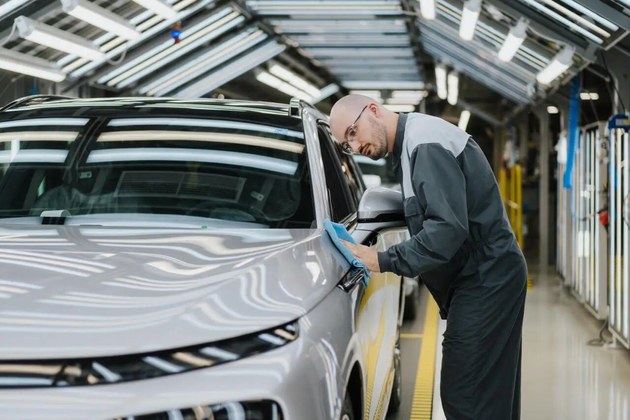
Local manufacturing is the cornerstone of BYD’s European strategy. In late 2023, BYD announced the construction of its first European passenger vehicle production facility in Szeged, Hungary, with a total investment of approximately €2 billion. The plant is designed for an initial annual capacity of 150,000 vehicles, with long-term expansion potential to 300,000 units.
The factory, originally planned to begin production in 2025, will focus on popular battery electric vehicle models and battery-related components, significantly reducing BYD’s exposure to tariffs, logistics costs, and regulatory friction.
Beyond Hungary, BYD has also confirmed plans to begin production in Turkey in 2026, forming a dual manufacturing hub structure of “Hungary + Turkey.” This layout enables BYD to efficiently serve both core European Union markets and surrounding regions.
As BYD Executive Vice President Li Ke stated at the 2025 Munich Auto Show, the company aims to complete localized production for most European EV models by 2028, allowing faster response to regional demand and improved supply chain efficiency.
R&D and Product Localization: Building Long-Term Competitive “Soft Power”
Manufacturing alone is not enough to win Europe. BYD has invested heavily in localized research, development, and product adaptation.
In May 2025, BYD announced a 100 billion Hungarian forint investment in Budapest to establish its European headquarters and R&D center, creating approximately 2,000 local jobs. This facility functions as a central hub for sales coordination, after-sales service, vehicle testing, regulatory validation, and localized product development.
This structure allows BYD to react quickly to European consumer preferences. For example, recognizing charging infrastructure gaps in certain regions, BYD strategically introduced plug-in hybrid models in late 2023, easing range anxiety and accelerating market adoption.
Such product localization strengthens BYD’s competitiveness beyond pricing, positioning the brand as a long-term participant rather than a short-term exporter.
Expanding Sales and Service Networks: Reaching the Consumer “Last Mile”
A dense and responsive retail network is critical in Europe’s fragmented automotive market. BYD plans to establish over 1,000 sales and service outlets across 32 European countries by the end of 2025, with the goal of expanding to 2,000 outlets by the end of 2026.
This aggressive expansion improves brand visibility while significantly reducing service response times. For European consumers, localized service availability builds trust—one of the biggest barriers for newer automotive brands entering mature markets.
BYD’s transition from distributor-led entry to fully localized sales, service, and manufacturing reflects a consistent focus on deep market integration and long-term presence.
Conclusion: BYD’s European Strategy Signals a Structural Shift
BYD’s rise in Europe is not the result of short-term price competition, but the outcome of a capital-intensive, vertically integrated, and localization-driven strategy. While this “heavy-asset” model requires substantial upfront investment and operational complexity, early results—such as overtaking Tesla in monthly European sales—suggest the approach is paying off.
As BYD continues to expand local production, strengthen R&D capabilities, and scale its sales network, it is positioning itself as a permanent force in the European automotive market. More importantly, BYD’s success signals a broader transformation in the global EV industry, where Chinese automakers are no longer peripheral challengers but central players shaping the future of sustainable mobility.

I’m not that much of a online reader to be honest but your sites really nice, keep it up! I’ll go ahead and bookmark your site to come back later on. All the best